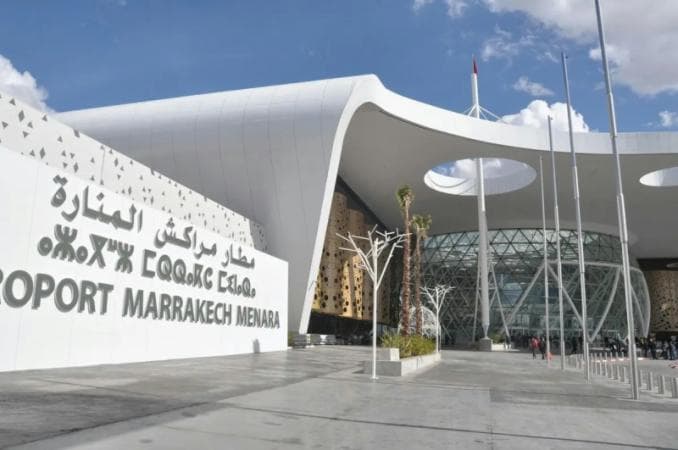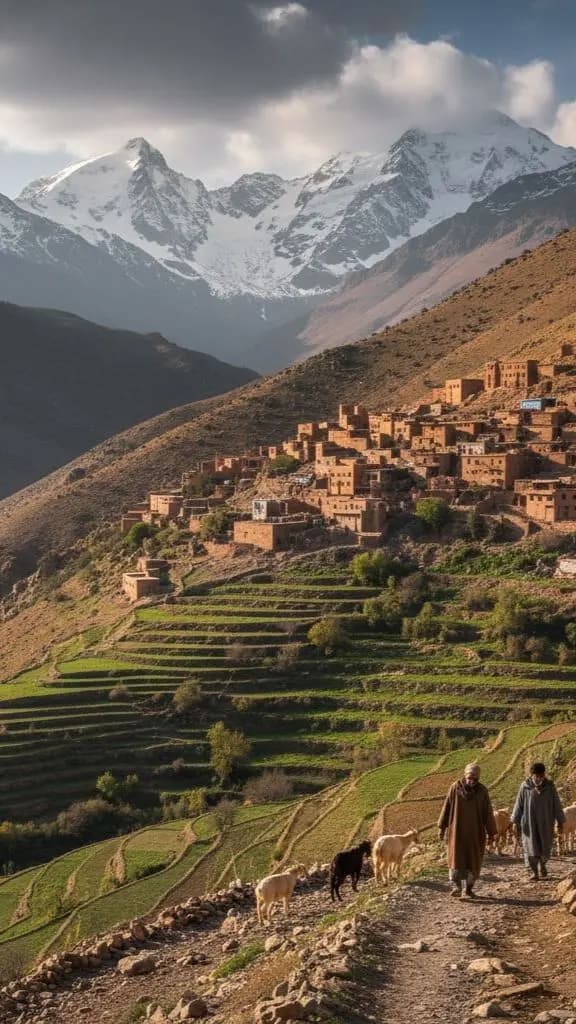
Once you have your rental car at Marrakech Menara, the High Atlas is the day trip every first-time visitor underestimates and remembers years later. Snow-capped peaks visible from your car window thirty minutes out of the city is the Morocco postcard people fly here for.
This guide is the practical version: which valley to pick, what the road is actually like, and the vehicle question that matters more than people think.
The two valleys: Ourika or Imlil?
From Marrakech you have two famous routes south into the High Atlas. They go in roughly the same direction but they are very different days.
Ourika valley (45 km, 1h15 each way): the easier option. The road follows the river through a string of riverside restaurants on stilts, pottery workshops, and Berber villages. The endpoint is Setti Fatma, where you can walk thirty minutes to the first of seven waterfalls. The valley sits below 1,800 m and stays warm even in winter.
Imlil (65 km, 1h45 each way): the mountain option. The road climbs through the Asni valley to 1,740 m. Imlil itself is a single-street village at the foot of Toubkal, North Africa's highest peak. The drive has serious switchbacks for the last 25 km — beautiful but demanding. Plan a full day: leave Marrakech by 8 AM, lunch in Imlil, back in Marrakech before 7 PM.
If you have one day for the Atlas: Ourika in spring/summer, Imlil if you want the views and don't mind the switchbacks.
Why an SUV (not a 4×4) is the right call
Tourists see "Atlas Mountains" on the map and assume they need a 4×4. They don't.
The road from Marrakech to Imlil is fully paved. The road from Marrakech to Setti Fatma is fully paved. Both routes are physically driveable in a Dacia Sandero. We have customers who do it every week.
What an SUV (Dacia Duster, Hyundai Tucson, Renault Captur class) gives you:
- Suspension comfort over the patched tarmac near villages — the road has been potholed in places since the September 2023 quake repairs.
- Higher driving position on blind switchbacks where seeing two corners ahead matters.
- More space for the souvenirs you will inevitably buy on the way back.
A real 4×4 (Hilux, Ranger, L200) is only needed if you intend to drive off the paved road — into the upper Imlil pastures, on the dirt tracks above Aroumd village, or to remote Berber settlements. For a normal day trip, the SUV is the sweet spot.
Driving rules and customs you actually need to know
Three things that catch first-time visitors:
- Speed limits drop sharply in villages. 60 km/h on main road, 40 km/h crossing a village, sometimes signed at 20 km/h near schools. Fines are a flat 300–500 MAD if a gendarme catches you, payable on the spot in cash.
- Police checkpoints. You will pass at least one on the way down and one on the way back. They almost always wave tourists through with a smile. Have your passport and rental contract handy in the glovebox just in case.
- Headlights on. By Moroccan code you must drive with low-beam headlights on outside cities, day and night, year-round. Most modern cars do it automatically — confirm before you leave the rental.
Fuel, food and parking on the way
Fuel up before leaving Marrakech — there are stations at Asni and Setti Fatma but they sometimes run dry on weekends. A full Sandero tank gets you to Imlil and back twice over with margin.
For lunch on the way back, the riverside restaurants in Ourika serve tagine and lamb skewers on tables literally over the water. Touristy but authentic; expect 80–120 MAD/person. In Asni on the Imlil road, locals favour the grilled meat stalls in the Saturday market — much cheaper, much more local.
Parking in Imlil is paid (10 MAD/day) at two lots at the village entrance. In Ourika villages you generally park on the roadside; a parking guardian usually appears with a yellow vest — 5–10 MAD is the right tip.
What to bring beyond the obvious
- Cash in 50/100 MAD notes — most village cafes don't take cards.
- A jacket. Imlil at 1,740 m is 8–10°C cooler than Marrakech, year-round.
- Walking shoes if you plan to do the waterfalls in Ourika or any short hike from Imlil.
- Sunglasses and water — even in winter, the Atlas sun is intense at altitude.
Sample one-day itinerary
- 08:00 Pick up the car / leave Marrakech via the Casablanca road, exit south at Tahanaout.
- 09:30 Coffee stop in Asni or Tahanaout.
- 10:30 Arrive Imlil. Park, walk into the village, do the 90-minute loop to Aroumd.
- 13:00 Lunch in Imlil (Kasbah du Toubkal terrace if budget allows; otherwise local stalls).
- 15:00 Drive down toward Setti Fatma, brief Ourika stop for waterfall photos.
- 17:30 Back in Marrakech, sunset on the Koutoubia.
Booking the right car
Our SUV fleet (Dacia Duster, Hyundai Tucson, Renault Captur) starts at 450 MAD/day with full insurance and unlimited kilometres. For a one-day Atlas trip we strongly recommend Premium insurance (+80 MAD) — it reduces the deductible to zero and covers tyres and bodywork against the loose stones the road throws up. See SUV options or message us on WhatsApp for a quote.